If you've invested time and money into sealing your concrete surfaces—whether it's a driveway, patio, garage floor, or basement foundation—one of the most important questions you'll have is how long does concrete sealant last before it needs reapplication. Understanding the lifespan of different concrete sealers helps you plan maintenance, budget for future projects, and ensure your concrete remains protected against water, stains, UV damage, and wear. This comprehensive guide answers all your questions about how long does concrete sealant last for different product types, under various conditions, and how to maximize the longevity of your investment.
Why Knowing Concrete Sealant Lifespan Matters
Understanding how long does concrete sealant last isn't just about scheduling your next project—it directly affects the protection your concrete receives. Concrete is porous and vulnerable to:
- Water penetration: Freeze-thaw cycles can crack and spall unprotected concrete.
- Staining: Oil, grease, and other substances permanently mark unsealed concrete.
- UV damage: Sunlight can fade and deteriorate concrete surfaces over time.
- Chemical attack: De-icing salts, acids, and other chemicals can erode concrete.
- Abrasion: Foot and vehicle traffic wear down unprotected surfaces.
A quality concrete sealant creates a protective barrier that prevents these issues. But when that sealant fails, your concrete becomes vulnerable again. Knowing how long does concrete sealant last helps you:
- Plan maintenance: Schedule reapplication before protection fails completely.
- Budget effectively: Spread the cost of resealing over predictable intervals.
- Choose the right product: Select sealers based on their expected lifespan for your specific application.
- Inspect properly: Know what signs indicate your sealant is nearing the end of its life.
- Protect your investment: Ensure continuous protection for your concrete surfaces.
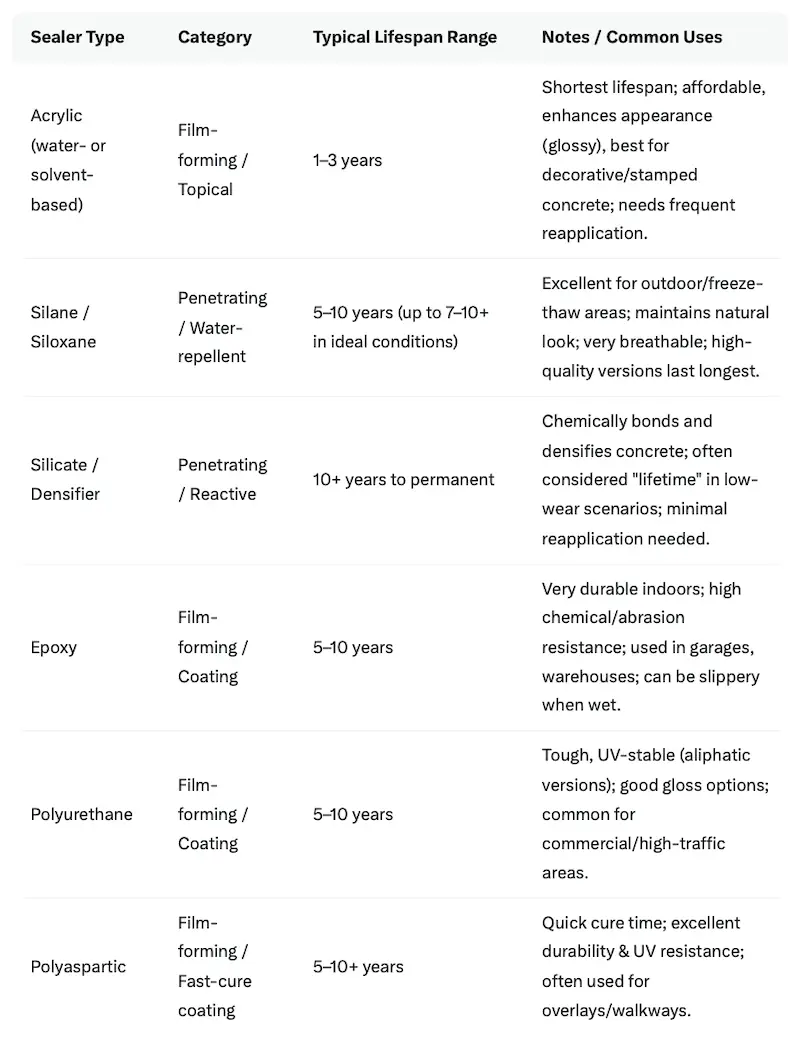
Average Lifespan: How Long Does Concrete Sealant Last by Type?
The answer to how long does concrete sealant last varies dramatically based on the type of sealer you choose. Here's a breakdown by sealer category:
Acrylic Concrete Sealers
Acrylic sealers are among the most popular choices for decorative concrete, driveways, and patios due to their affordability, ease of application, and good appearance.
- Typical lifespan: 1-3 years
- Best for: Interior floors, decorative concrete, low-traffic areas, and applications where appearance is important and frequent reapplication is acceptable.
- Characteristics: Acrylics form a thin film on the surface that enhances color and provides good protection. However, they wear relatively quickly under traffic and UV exposure.
- Variations:
- Water-based acrylic: 1-2 years, more environmentally friendly, less odor
- Solvent-based acrylic: 2-3 years, better penetration and durability, stronger odor
- Acrylic with urethane additives: 3-4 years, enhanced durability
When asking how long does concrete sealant last for acrylics, expect to reapply every 1-3 years depending on traffic and exposure.
Epoxy Concrete Sealers
Epoxy sealers are two-part systems that cure through chemical reaction, creating an extremely durable, high-build coating.
- Typical lifespan: 3-7 years for standard epoxies, 7-10+ years for high-performance formulations
- Best for: Garage floors, commercial spaces, industrial floors, and areas requiring maximum durability and chemical resistance.
- Characteristics: Epoxies form a thick, hard film that resists abrasion, chemicals, and impacts. They're more expensive and require more careful application than acrylics.
- Variations:
- Water-based epoxy: 3-5 years, easier application, lower VOCs
- Solvent-based epoxy: 5-7 years, better chemical resistance
- 100% solids epoxy: 7-10+ years, maximum durability, no VOCs
Epoxies offer a much longer answer to how long does concrete sealant last, making them cost-effective for high-use areas despite higher initial cost.
Polyurethane Concrete Sealers
Polyurethane sealers offer excellent durability combined with UV stability, making them ideal for exterior applications.
- Typical lifespan: 3-7 years for exterior, 5-10 years for interior
- Best for: Exposed aggregate, stamped concrete, driveways, patios, and areas requiring both durability and UV resistance.
- Characteristics: Polyurethanes are flexible, abrasion-resistant, and maintain clarity better than epoxies under sunlight. They're often used as topcoats over epoxy systems.
- Variations:
- Aliphatic polyurethane: 5-7 years, excellent UV resistance, non-yellowing
- Aromatic polyurethane: 3-5 years, may amber with UV exposure
- Moisture-cure urethane: 5-7 years, professional application required
Penetrating Concrete Sealers
Penetrating sealers (also called densifiers, siliconates, or silanes/siloxanes) work differently—they absorb into the concrete and react chemically to block pores rather than forming a surface film.
- Typical lifespan: 3-5 years for siloxanes, 5-7 years for silanes, 7-10+ years for siliconates
- Best for: Driveways, sidewalks, patios, foundations, and any area where you want protection without changing the surface appearance.
- Characteristics: Penetrating sealers are invisible, don't change surface texture, and protect against water and chloride intrusion without creating a film that can wear or peel.
- Variations:
- Siloxane: 3-5 years, good water repellent, affordable
- Silane: 5-7 years, deeper penetration, better for dense concrete
- Siliconate: 7-10+ years, reacts with concrete for long-term protection
When considering how long does concrete sealant last for penetrating products, remember they don't wear visibly—they gradually lose effectiveness, making regular water beading tests important.
Polyaspartic Concrete Sealers
Polyaspartic sealers are a newer technology offering extremely fast cure times combined with excellent durability.
- Typical lifespan: 5-10 years for clear coats, 10-15+ years for pigmented systems
- Best for: Garage floors, commercial spaces, and applications requiring rapid turnaround and long-term durability.
- Characteristics: Polyaspartics cure in hours rather than days, offer excellent UV stability, and provide durability comparable to epoxies. They're more expensive and require professional application.
- Variations:
- Clear polyaspartic: 5-8 years
- Pigmented polyaspartic: 8-12 years
- Polyaspartic with flake systems: 10-15+ years
Polyaspartics offer one of the longest answers to how long does concrete sealant last, making them excellent investments for high-use areas despite higher initial cost.
Factors That Affect How Long Does Concrete Sealant Last
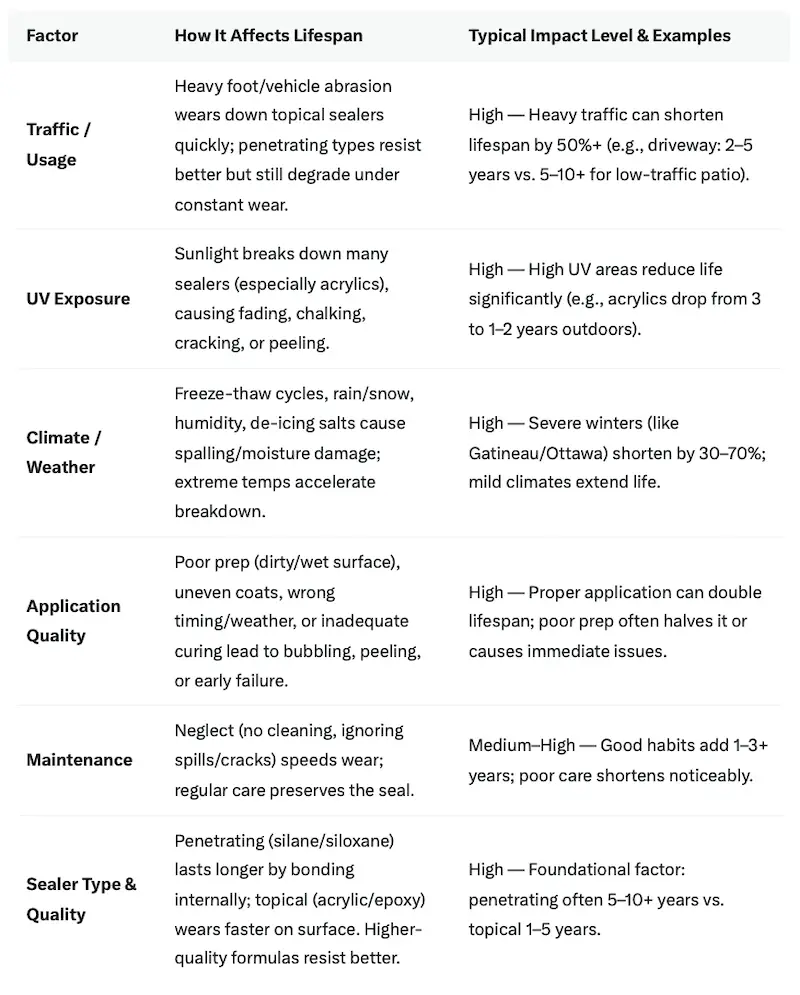
The answer to how long does concrete sealant last isn't determined solely by the product you choose—several environmental and application factors significantly impact actual lifespan. Understanding these variables helps you select the right sealer and maximize its longevity.
Traffic and Abrasion Levels
How much traffic your concrete surface receives dramatically affects how long does concrete sealant last.
- Light traffic (patios, walkways, interior floors): Sealers last closest to manufacturer maximums. Minimal wear means the protective film remains intact longer.
- Moderate traffic (residential driveways, garage floors): Regular vehicle and foot traffic gradually wears sealer. Expect lifespans at the middle to lower end of ranges.
- Heavy traffic (commercial spaces, public walkways): High abrasion significantly reduces sealer life. Film-forming sealers may need reapplication at the shortest recommended intervals.
- Point loads: Areas under vehicle tires, heavy furniture legs, or constant foot traffic paths wear faster than surrounding areas. This is particularly relevant when asking how long does concrete sealant last in specific spots.
For high-traffic areas, consider more durable sealers like epoxies or polyaspartics, which offer longer answers to how long does concrete sealant last despite higher abrasion.
UV Exposure and Sunlight
Sunlight, particularly UV radiation, degrades many sealers over time, directly affecting how long does concrete sealant last for exterior applications.
- Full sun exposure: UV rays break down the chemical bonds in sealers, causing them to become brittle, chalky, and less effective. Acrylics are particularly vulnerable, often lasting only 1-2 years in full sun.
- Partial shade: Reduced UV exposure extends sealer life. North-facing surfaces or those shaded by trees or buildings may last 25-50% longer.
- Full shade/interior: Minimal UV exposure allows sealers to reach their maximum potential lifespan.
- UV-resistant formulations: Polyurethanes (especially aliphatic) and polyaspartics offer excellent UV resistance, providing much longer answers to how long does concrete sealant last in sunny locations.
When sealing exterior concrete, consider UV exposure in your product selection. The wrong sealer in full sun will disappoint regardless of other factors affecting how long does concrete sealant last.
Climate and Weather Conditions
Your local climate plays a major role in determining how long does concrete sealant last.
- Freeze-thaw cycles: In northern climates like Quebec and Ontario, repeated freezing and thawing stresses both concrete and sealer. Water that penetrates minor sealer defects expands when frozen, widening cracks and accelerating sealer failure. This harsh environment means sealers may last at the lower end of their range.
- Extreme heat: Prolonged high temperatures can soften some sealers and accelerate UV degradation. Surfaces that absorb heat (like dark driveways) experience additional thermal stress.
- Precipitation and humidity: Constant moisture exposure can degrade sealers over time. Humid environments may promote mildew growth on sealer surfaces.
- Chemical exposure: De-icing salts, pool chemicals, and industrial pollutants can chemically attack sealers, reducing how long does concrete sealant last.
In harsh climates, choose sealers specifically formulated for your conditions and expect more frequent reapplication than in mild environments.
Concrete Quality and Condition
The concrete itself affects how long does concrete sealant last through its quality and condition at application.
- New, properly cured concrete: Provides the best substrate for sealer adhesion. Sealers applied to concrete that has cured for 28+ days typically last longest.
- Dense, low-porosity concrete: May not allow deep penetration of sealers, potentially affecting film-forming sealer adhesion. Surface preparation (etching) may be needed.
- Porous or damaged concrete: Absorbs more sealer, potentially reducing film thickness and protection. Pre-existing cracks or spalls will continue to move, potentially stressing adjacent sealer.
- Previously sealed concrete: If old sealer isn't completely removed, new sealer may not bond properly, dramatically reducing how long does concrete sealant last.
- Moisture content: Sealing damp concrete traps moisture, leading to blistering and premature failure regardless of sealer quality.
Proper surface preparation is essential for maximizing how long does concrete sealant last. Starting with clean, dry, sound concrete gives your sealer the best chance to achieve its full lifespan.
Application Quality
How you apply the sealer significantly impacts how long does concrete sealant last.
- Proper coverage rate: Applying at the manufacturer's recommended rate ensures adequate film thickness. Too thin provides insufficient protection; too thick may crack or peel.
- Even application: Uniform coverage prevents thin spots that fail early and thick spots that may crack.
- Correct temperature and humidity: Applying within specified ranges ensures proper curing and maximum lifespan.
- Proper mixing: Two-part systems (epoxies, polyaspartics) must be mixed precisely for complete cure.
- Number of coats: Multiple thin coats typically outperform one thick coat, often extending how long does concrete sealant last.
Following manufacturer instructions precisely is the single most important factor you control in determining how long does concrete sealant last for your project.
Signs Your Concrete Sealant Is Nearing the End of Its Life
Knowing when to reapply sealant is just as important as knowing how long does concrete sealant last on paper. Here are visual and physical indicators that your sealant needs attention:
Visual Indicators for Film-Forming Sealers (Acrylic, Epoxy, Polyurethane, Polyaspartic)
- Loss of gloss: The surface becomes dull or matte where it was once glossy. This indicates the top layer of sealer has worn away.
- Peeling or flaking: Visible areas where sealer is lifting from the concrete. This requires complete removal and reapplication.
- Blistering or bubbling: Small bubbles or blisters indicate sealer failure, often due to moisture or poor adhesion.
- White or cloudy patches: Blushing or hazing indicates moisture damage or sealer degradation.
- Scuff marks or traffic patterns: Visible wear patterns, especially in high-traffic areas, show the sealer is thinning.
- Color changes: Fading or yellowing (especially in acrylics) indicates UV degradation and loss of protection.
- Chalking: A powdery residue on the surface when wiped indicates sealer breakdown.
Indicators for Penetrating Sealers
Since penetrating sealers are invisible, different signs indicate they're no longer effective. These answer how long does concrete sealant last for invisible protectors:
- Water absorption: Water no longer beads on the surface but soaks in, darkening the concrete. This is the most reliable test.
- Staining: Oil or other spills leave stains that don't wipe away, indicating the repellent properties are gone.
- Efflorescence: White mineral deposits on the surface indicate water is moving through the concrete.
- Increased spalling or scaling: Surface deterioration suggests water penetration and freeze-thaw damage.
Simple Tests to Check Sealant Condition
- Water beading test: Sprinkle water on the surface. If it beads up and rolls off, sealant is still effective. If it soaks in and darkens the concrete, it's time to reapply. This directly answers how long does concrete sealant last for your specific situation.
- Adhesion test: Apply duct tape firmly, then remove. If sealer comes off with the tape, it's failing and needs attention.
- Scrape test: Gently scrape the surface with a coin or putty knife. If sealer flakes off easily, it's deteriorated.
- Visual inspection: Examine the surface in raking light (low angle) to spot thin areas or wear patterns.
Regular testing helps you determine how long does concrete sealant last in your specific conditions and reapply before protection fails completely.
How to Extend How Long Concrete Sealant Lasts
While you can't change the fundamental chemistry of your sealer, proper maintenance can significantly extend its effective life. Here's how to maximize how long does concrete sealant last:
Regular Cleaning
- Gentle cleaning: Regularly sweep and wash with mild soap and water. Avoid harsh chemicals that can degrade sealers.
- Prompt spill cleanup: Oil, grease, and chemicals can penetrate and damage sealers if left standing. Clean spills immediately.
- Avoid pressure washing: High-pressure washing can damage film-forming sealers. If needed, use low pressure and keep nozzle moving.
- Mild detergents only: Harsh degreasers or acidic cleaners can attack sealers. Use products recommended for sealed concrete.
Protection from Damage
- Use mats and pads: In high-traffic areas, entry mats reduce abrasion. Furniture pads prevent point-load damage.
- Avoid dragging: Don't drag heavy items across sealed concrete—lift them or use protective sliders.
- Winter care: Use plastic shovels rather than metal. Avoid sharp snowplow blades. Use sand for traction rather than de-icers when possible.
- Shade protection: For exterior concrete, consider awnings or shade structures to reduce UV exposure and extend how long does concrete sealant last.
Timely Maintenance
- Touch up thin areas: For film-forming sealers, a light maintenance coat in high-wear areas can extend overall life without full reapplication.
- Address damage promptly: Small areas of peeling or wear can be spot-repaired before they spread.
- Keep records: Note when you applied sealer and what product you used. This helps track expected lifespan and plan reapplication.
With proper care, you can often add 25-50% to the typical answer for how long does concrete sealant last, maximizing your investment and protecting your concrete longer.
How Long Does Concrete Sealant Last in Different Applications?
The answer to how long does concrete sealant last varies significantly based on where and how it's used. Here's what to expect for common concrete applications:
Driveways and Parking Areas
Driveways face vehicle traffic, UV exposure, weather extremes, and chemical exposure (de-icers, oil spills). These demanding conditions significantly affect how long does concrete sealant last.
- Acrylic sealers: 1-2 years. Vehicle traffic wears acrylics relatively quickly, especially in tire tracks. UV exposure accelerates degradation.
- Penetrating sealers: 3-5 years for siloxanes, 5-7 years for silanes. Provide good protection without surface wear, but gradually lose effectiveness.
- Epoxy sealers: 3-5 years for standard epoxies. However, epoxies may yellow in sunlight and require a UV-resistant topcoat.
- Polyurethane sealers: 3-6 years. Offer good UV resistance and durability for driveways.
- Polyaspartic sealers: 5-10 years. Excellent durability and UV resistance make them ideal for driveways despite higher cost.
For driveways, the answer to how long does concrete sealant last typically falls at the lower end of manufacturer ranges due to harsh exposure and traffic.
Garage Floors
Garage floors face vehicle traffic, chemical exposure (oil, antifreeze), and sometimes hot tires, but are protected from UV and weather.
- Acrylic sealers: 1-2 years. Not ideal for garages due to limited chemical resistance and durability.
- Penetrating sealers: 3-5 years. Protect against oil stains but don't provide a glossy finish.
- Epoxy sealers: 5-7 years for quality epoxies. The standard for garage floors due to excellent durability and chemical resistance.
- Polyurethane sealers: 5-7 years as topcoats over epoxy.
- Polyaspartic sealers: 7-12 years. Increasingly popular for garages due to fast cure and exceptional durability.
When asking how long does concrete sealant last in garages, epoxy and polyaspartic systems offer the best longevity, often exceeding 5-10 years with proper installation.
Patios and Walkways
Patios and walkways face foot traffic, UV exposure, and weather, but not vehicle loads. Aesthetics are often important.
- Acrylic sealers: 2-3 years. Popular for decorative concrete due to color enhancement and affordability, but require frequent reapplication.
- Penetrating sealers: 3-5 years. Maintain natural appearance while protecting against moisture and stains.
- Polyurethane sealers: 4-6 years. Excellent UV resistance and durability for exposed aggregate or stamped concrete.
- Epoxy sealers: Not typically used alone on patios due to UV sensitivity (yellowing).
- Polyaspartic sealers: 5-8 years. Offer durability and UV resistance but at higher cost.
For patios, the answer to how long does concrete sealant last depends on whether you prioritize appearance (acrylics, reapplied frequently) or longevity (polyurethanes, longer intervals).
Basement Floors and Foundations
Interior concrete faces minimal UV and traffic but may have moisture challenges. Protection against water vapor and stains is primary.
- Acrylic sealers: 2-4 years. Can work for low-moisture basements but may not block vapor effectively.
- Penetrating sealers: 5-10 years. Excellent for blocking moisture vapor without changing appearance.
- Epoxy sealers: 5-10 years. Provide durable, moisture-resistant coatings for basement floors.
- Polyurethane sealers: 5-10 years as topcoats.
In basements, how long does concrete sealant last can be at the maximum range due to protected conditions, provided moisture isn't actively damaging the sealer from below.
Commercial and Industrial Floors
Commercial spaces face intense traffic, heavy loads, and often chemical exposure, demanding maximum durability.
- Epoxy systems: 5-10 years for quality installations. Often specified for warehouses, factories, and retail.
- Polyurethane systems: 5-10 years, often as topcoats over epoxy.
- Polyaspartic systems: 7-12 years. Used in demanding applications requiring rapid return to service.
- Penetrating sealers: 3-5 years, used where surface appearance isn't critical.
For commercial applications, how long does concrete sealant last depends heavily on traffic levels and maintenance. High-quality systems with proper maintenance can achieve maximum lifespans even in demanding conditions.
Pool Decks and Wet Areas
Pool decks face constant moisture, chlorine exposure, and barefoot traffic requiring slip resistance.
- Acrylic sealers: 1-2 years. Affordable but require frequent reapplication due to chlorine and UV exposure.
- Penetrating sealers: 2-4 years. Protect against moisture without creating slippery surfaces.
- Polyurethane sealers: 3-5 years. Good chemical resistance and UV stability, often with slip-resistant additives.
- Epoxy sealers: Not typically used alone due to UV sensitivity and potential slipperiness.
When asking how long does concrete sealant last around pools, expect shorter lifespans due to chemical exposure and choose products specifically formulated for these conditions.
How to Choose the Right Sealer Based on Desired Lifespan
When selecting a concrete sealer, consider how long you want between reapplications. Here's guidance based on your priorities for how long does concrete sealant last:
If You Want Maximum Longevity (5-10+ Years)
- Choose: 100% solids epoxy, polyaspartic, or high-quality polyurethane systems
- Best for: Garage floors, commercial spaces, high-traffic areas, and applications where frequent resealing is impractical
- Trade-offs: Higher initial cost, professional installation often required, longer cure times (except polyaspartic)
- Expectation for how long does concrete sealant last: 7-12 years with proper maintenance
If You Want Good Durability (3-7 Years)
- Choose: Solvent-based acrylics with urethane additives, quality epoxies, or penetrating silanes/siloxanes
- Best for: Driveways, patios, walkways, and residential applications balancing cost and longevity
- Trade-offs: Moderate cost, may be DIY-friendly, reasonable protection
- Expectation for how long does concrete sealant last: 3-5 years typically
If You Want Low Cost and Easy Reapplication (1-3 Years)
- Choose: Water-based or standard solvent-based acrylics
- Best for: Decorative concrete, rental properties, or situations where appearance matters and frequent reapplication is acceptable
- Trade-offs: Lowest cost, easiest application, but requires regular maintenance
- Expectation for how long does concrete sealant last: 1-3 years depending on exposure
Cost Considerations: Longevity vs. Investment
Understanding how long does concrete sealant last helps you evaluate cost-effectiveness. Here's how to calculate value:
Cost Per Year Analysis
When comparing sealers, don't just look at initial cost—calculate cost per year of protection:
- Acrylic sealer: $0.15-$0.30 per square foot installed, lasting 2 years = $0.075-$0.15 per square foot per year
- Epoxy sealer: $0.50-$1.50 per square foot installed, lasting 5 years = $0.10-$0.30 per square foot per year
- Polyaspartic sealer: $1.00-$2.50 per square foot installed, lasting 8 years = $0.125-$0.31 per square foot per year
- Penetrating sealer: $0.30-$0.80 per square foot installed, lasting 4 years = $0.075-$0.20 per square foot per year
This analysis shows that while premium sealers cost more initially, their annual cost can be comparable to or even lower than cheaper alternatives when considering how long does concrete sealant last.
Other Economic Factors
- Labor savings: Less frequent reapplication means lower labor costs over time, especially if hiring professionals.
- Downtime: Longer-lasting sealers mean less frequent disruption to use of the space.
- Protection value: Better sealers provide superior protection, potentially preventing costly concrete repairs or replacement.
- Property value: Well-maintained, attractive concrete enhances property appearance and value.
When evaluating how long does concrete sealant last, consider the total cost of ownership, not just the initial price tag.
Regional Differences in Concrete Sealant Lifespan
Your geographic location significantly affects how long does concrete sealant last. Here's what to expect in different regions:
Northern Climates (Quebec, Ontario, Northern US)
- Typical lifespan reduction: 25-40% shorter than manufacturer maximums
- Key factors: Freeze-thaw cycles stress sealers, de-icing chemicals attack coatings, snow removal equipment causes abrasion
- Best choices: Penetrating sealers for driveways (resist freeze-thaw), polyaspartics for garages (durable, fast-curing), epoxies for interior
- Expectation for how long does concrete sealant last: Acrylics 1-2 years, epoxies 3-5 years, polyaspartics 5-8 years
Southern Climates (Southern US, Warm Regions)
- Typical lifespan reduction: 15-30% shorter due to UV and heat
- Key factors: Intense UV degradation, high temperatures softening some sealers, occasional hurricane exposure
- Best choices: Aliphatic polyurethanes (UV-resistant), polyaspartics, penetrating sealers for driveways
- Expectation for how long does concrete sealant last: Acrylics 1-2 years, polyurethanes 3-5 years, polyaspartics 5-8 years
Coastal Areas
- Typical lifespan reduction: 30-50% shorter
- Key factors: Salt spray accelerates degradation, high humidity, frequent storms
- Best choices: Marine-grade polyurethanes, high-quality penetrating sealers, epoxy with UV-resistant topcoats
- Expectation for how long does concrete sealant last: Acrylics 1 year or less, epoxies 2-4 years with proper topcoats, penetrating sealers 2-3 years
Understanding regional impacts helps you set realistic expectations for how long does concrete sealant last in your specific location and choose products accordingly.
How to Extend the Life of Your Concrete Sealant
While you can't change the fundamental chemistry of your sealer, proper maintenance and care can significantly extend how long does concrete sealant last. Here are proven strategies to maximize your investment:
Regular Cleaning and Maintenance
- Sweep regularly: Remove dirt and debris that can abrade the sealer surface over time. Use a soft broom to avoid scratching.
- Clean spills immediately: Oil, grease, and chemicals can penetrate and degrade sealers if left standing. Blot spills rather than wiping to avoid spreading.
- Use gentle cleaners: Mild soap and water is usually sufficient. Avoid harsh chemicals, degreasers, or acidic cleaners that can attack the sealer.
- Rinse thoroughly: Soap residue left on the surface can attract dirt and potentially degrade some sealers over time.
- Avoid pressure washing: High-pressure water can damage film-forming sealers. If necessary, use low pressure (under 1500 psi) with a wide fan tip and keep the nozzle moving.
Protective Measures
- Use mats in high-traffic areas: Entry mats at doorways reduce abrasion from foot traffic and trap grit that would otherwise grind into the sealer.
- Furniture pads: Place felt or rubber pads under furniture legs to prevent point-load damage and scratching.
- Avoid dragging: Lift heavy items rather than dragging them across sealed concrete. Dragging creates concentrated abrasion that can quickly wear through sealers.
- Vehicle precautions: Avoid turning wheels while parked, as this twisting action can abrade sealers. Consider parking in different spots occasionally to distribute wear.
- Winter care: Use plastic shovels rather than metal blades. Avoid sharp snowplow blades. Use sand for traction rather than de-icing salts when possible.
Environmental Protection
- Shade structures: For exterior concrete, consider awnings, pergolas, or shade sails to reduce UV exposure and extend how long does concrete sealant last.
- Improve drainage: Ensure water doesn't pool on sealed surfaces. Standing water can degrade sealers over time and may penetrate through minor defects.
- Control vegetation: Keep plants, moss, and algae from growing on sealed surfaces. Their roots and moisture retention can damage sealers.
Timely Reapplication Strategies
- Don't wait for complete failure: Reapply when you notice the first signs of wear—loss of gloss, reduced water beading, or thin spots in traffic areas.
- Spot maintenance: For film-forming sealers, a light maintenance coat in high-wear areas can extend overall life without full reapplication.
- Proper surface preparation: When reapplying, ensure the surface is clean and properly prepared. Light sanding or etching may be needed for adhesion.
- Keep records: Note when you applied sealer, what product you used, and any maintenance performed. This helps track expected lifespan and plan reapplication.
With proper care, you can often add 25-50% to the typical answer for how long does concrete sealant last, maximizing your investment and protecting your concrete longer.
Frequently Asked Questions About Concrete Sealant Lifespan
Can I apply new sealer over old sealer?
Sometimes, but it depends on the condition of the existing sealer and compatibility of products. If the old sealer is sound and well-adhered, you may be able to apply a compatible new coat after proper cleaning and light abrasion. However, if the old sealer is peeling, flaking, or failing, it must be completely removed before new sealer application. Mixing incompatible sealer types can lead to adhesion failure and dramatically reduce how long does concrete sealant last.
How do I know when it's time to reapply?
The water beading test is most reliable: sprinkle water on the surface. If it beads up and rolls off, the sealer is still effective. If it soaks in and darkens the concrete, it's time to reapply. Other signs include loss of gloss, visible wear patterns, staining that doesn't clean easily, or efflorescence (white mineral deposits) appearing on the surface.
Does a thicker coat of sealer last longer?
Not necessarily—and it can actually cause problems. Applying sealer thicker than manufacturer recommendations can lead to cracking, peeling, and trapped solvents that never fully cure. Multiple thin coats, applied according to instructions, provide better protection and often longer life than one thick coat. The key to maximizing how long does concrete sealant last is proper application, not excessive thickness.
Will sealing my concrete make it last longer?
Yes, absolutely. Quality sealers protect concrete from water penetration, freeze-thaw damage, staining, and chemical attack. This protection can significantly extend the life of the concrete itself. While the sealer needs periodic reapplication, it's far more economical to maintain sealers than to repair or replace damaged concrete. The answer to how long does concrete sealant last should be considered alongside how long your concrete will last with proper protection.
Do different colors or finishes affect lifespan?
Yes. Darker colors absorb more heat and UV radiation, which can accelerate sealer degradation in sunny locations. Glossy finishes may show wear more visibly than matte finishes, even when protection levels are similar. However, these are secondary factors—sealer chemistry and application quality matter far more than color or sheen when determining how long does concrete sealant last.
Conclusion
Understanding how long does concrete sealant last is essential for protecting your concrete investment and planning maintenance effectively. The answer varies dramatically based on sealer type—acrylics (1-3 years), epoxies (3-7 years), polyurethanes (3-7 years), penetrating sealers (3-10 years), and polyaspartics (5-15 years)—and is influenced by traffic levels, UV exposure, climate, application quality, and maintenance practices.
Remember these key takeaways for maximizing your concrete sealant's lifespan:
- Choose the right sealer for your application: Match sealer chemistry to your specific needs—durability for garages, UV resistance for patios, penetration for driveways, etc.
- Quality installation matters: Proper surface preparation, correct application thickness, and ideal conditions during application significantly extend sealer life.
- Consider total cost of ownership: Premium sealers with longer lifespans often provide better value than cheaper alternatives requiring frequent reapplication.
- Regular maintenance extends life: Gentle cleaning, prompt spill cleanup, and protective measures can add years to your sealer's effective life.
- Monitor and test regularly: Use water beading tests and visual inspections to track sealer condition and reapply before protection fails completely.
- Account for your location: Regional climate factors significantly affect lifespan—adjust expectations accordingly for northern, southern, or coastal areas.
By following these guidelines and understanding the factors that affect how long does concrete sealant last, you'll achieve durable, attractive concrete surfaces that provide lasting protection and enhance your property's value for years to come.
If you're looking for the best paving service provider in Laval, Montreal, or the entire Quebec region, look no further than Pavage Laval Asphalte Laval. Our team of experts is dedicated to meeting all your paving needs, providing high-quality and reliable services. Whether you're located in Laval, near Montreal, or elsewhere in Quebec, we're here to assist you with all your paving projects.
Don't hesitate to contact us today. You can reach us by phone at +1 (438) 476 6508, email us at pavage-asphalte-laval-montreal@outlook.com, or visit our website at pavage-asphalte-laval-montreal.ca for more information.
For those in need of paving and asphalt services near Gatineau, Quebec, we recommend contacting Pavage Gatineau Asphalte Gatineau Earnanswers. Our team of experts is ready to answer all your questions and provide quality solutions. To learn more or to request a quote, visit our website at pavagegatineau.com.
Approved sites
Further reading
- How Long Driveway Sealer Takes to Dry?
- How Long Driveway Sealer Last?
- How to Seal a Driveway
- Top Five Signs It's Time to Replace Your Asphalt Shingle Roof
- Parking Lot Striping: How Long It Takes to Dry and How Long It Lasts
- How Long does Gutter Sealant take to Dry ?
- How Long does Asphalt driveway Last ?
- How Long does Cement Sealer take to Dry ?
- How Long does Concrete Sealant Last ?
- How Long does Concrete Sealer take to Dry ?
- How long After new Asphalt before Sealing ?
Other services
Gutter Repair Tips Pavage Gatineau Earnanswers +1 (438) 476 6508
How Long does Concrete Sealant Last ?
We offer paving services in Laval, Quebec, specializing in asphalt for residential and commercial projects. info@asphaltesolution.com

Copyright © 2024
Propulsé par : Earnanswers

Contactez-nous
Pavaging Laval Asphalt Laval Earnanswers
If you're looking for quality paving near you, our team of Laval paving experts guarantees long-lasting results. We also serve the Montreal region and surrounding areas. Contact us for a quick quote on your asphalt needs in Laval and nearby locations.